
Found & Framed
Who we are
Found & Framed began with a single gift, a box of small treasures arranged behind glass to tell the story of someone deeply loved. It turned out that what we'd really made wasn't a frame at all, but a way to hold a memory still. That's what we do now. We gather the little things that carry meaning, perhaps a charm, or a pressed flower, or a handwritten note, or the ordinary bits and pieces of a life most extra-ordinary, and we frame them into something you'll want to keep forever. Every piece is one of one, made by hand, made with care, and made to remember. Because the things that matter most deserve more than a drawer or a photo on a phone. They deserve to be found and framed.

How did this come about
Found & Framed didn't start as a business. It started years ago, at university, with a student who couldn't afford much but could make almost anything with his hands. To bring in a little extra money to live on, he taught himself to craft, first paper sculpture and origami, folding and shaping single sheets into things people wanted to buy, and then, as his eye sharpened, shadow boxes built to house his own creations. No course, no workshop, no one showing him how. Just patience, a craft knife, and the quiet satisfaction of turning cheap materials into something someone would pay for. Those small sales helped a young student get by and, without him realising it at the time, taught him the very first lesson of every maker's business; that skill in your hands can become money in your pocket.
Life moved on, as it does. The craft knife went into a drawer and stayed there for years, then perhaps even got lost, while careers and responsibilities took over. Then, recently, came a birthday. He wanted to make something for his partner, not buy it, make it, and reached back for that old, half-forgotten talent. The result was a shadow box; a single frame holding the small objects that told the story of her life, each one chosen with care, arranged behind glass like a specimen worth keeping. It moved her. And in making it, he rediscovered something he'd nearly lost, that the hands that once paid his way through university could still make something that mattered.
But this time he saw it differently. He wasn't a struggling student anymore; he was someone who had spent a career learning how businesses are built. And looking at that birthday box, he recognised the same lesson he'd stumbled into all those years ago, only now he could name it, teach it, and prove it.
That's why Found & Framed exists. It's a craft-to-business story told out loud, on purpose, built to show young people with a talent and no roadmap that the thing they make in their spare time could become a living. Because he's done it twice now, once out of necessity, and once on purpose. And if a self-taught student folding paper to make rent could find his way to it, so can they.

The shadow box that started this journey
Every venture has a first piece. This was ours.
It began with a birthday, not just any birthday, but one that felt worth marking properly. We didn't want to buy something off a shelf. We wanted to make something that said I see your whole life, and all of it matters.
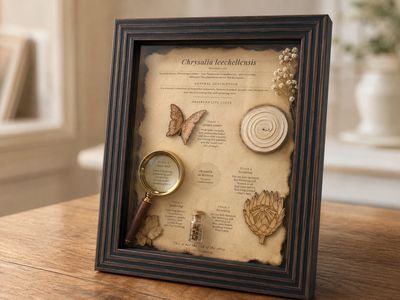
So we built a shadow box, and we styled it like a page from an old naturalist's field notebook, because the person it was for is, in the truest sense, a rare specimen. We gave her a Latin name, Chrysalia leechellensis, and we documented her the way a naturalist documents something precious and one of a kind, not a list of facts, but a life observed with love.
Inside the frame, we mapped her life as a series of stages, the way a living thing grows. A winged wonder, the wide-eyed curiosity of the beginning, when everything felt possible and the world was full of magic. A closer look, the years of learning, unlearning and relearning, of seeing deeper and choosing to grow. A gathering, the collecting of experiences, memories and people that quietly shape who you become. And a becoming, not yet fully bloomed, but blooming still, rooted in all that came before and reaching toward whatever comes next.
We tucked tiny seeds into a little glass bottle. We added a magnifying glass, the way you'd lean in to study something you didn't want to miss a single detail of. And at the bottom, where a scientific record might note an ending, we wrote the opposite, that this is not the end of the story. It's the becoming.
She loved it. But something else happened in the making of it. We realised that what we'd built wasn't a gift at all, it was proof. Proof that the most ordinary materials, arranged with enough care and enough meaning, could hold a whole human being. Proof that a thing made by hand could matter more than anything bought.
And in that proof was a question we couldn't put down, if this could mean so much to one person, what could it become?
That's the box that started Found & Framed. Everything since, every piece at the market, every potential commission, every young maker we hope to inspire, began with one frame, one life, and the decision to make it matter.
How we chose the name
We went looking for a name the way we build a box, by starting with what's actually inside it.
A shadow box is, at heart, two things; the finding and the framing. First you gather the small, scattered pieces of a story, the keepsakes, the curios, the little objects that would otherwise end up lost in a drawer. Then you frame them, arranging them with care into something whole, something worth hanging on a wall. The whole craft lives in those two movements; things found, then framed.
So the name was sitting there all along. Found & Framed. It says exactly what we do, in three words, with nothing to explain.
But we liked it for a quieter reason too. "Found" isn't only about objects; people get found in these boxes. A life that felt scattered gets gathered up and seen clearly, maybe for the first time. And "framed" isn't only about glass and timber; it's about giving something fleeting a place to stay. The things that matter most are so easily lost to time. Found & Framed is our small promise to keep them.
That's the name. Honest about the craft, and honest about why it matters.
Why this logo
We wanted a mark that looked made, not manufactured.
So the logo was hand-drawn in concept, an F and a D for Found and Framed, sketched in a single confident line rather than set in a clean, machine-perfect typeface. The strokes are a little uneven, a little human, the way a real pencil moves across real paper. That was deliberate. Everything we make is drawn, cut and arranged by hand, and we wanted the mark on the wall to say so before you've read a single word.
Look closely and you'll see the two letters aren't sitting side by side; they're woven into each other. The F nests inside the curve of the D, the same way a found object gets set inside a frame. Finding and framing aren't two separate steps in our work; they're one continuous motion. The logo holds them together exactly as the craft does.
And around it all runs the name in a quiet circle, like a maker's stamp pressed into the back of a finished piece, the small mark that says this was made by someone, and made with care.
It's simple, it's handmade, and it's honest about what we are. Which is everything we'd want a first impression to be.

Sourcing the frames
Behind every finished piece is an unglamorous question every maker eventually faces. Where do the materials actually come from, and what do they really cost? For us, the frame was the hardest part to get right and we got it wrong a few times before we got it close.
First, we improvised. In the beginning we used what was easy to find such as conventional A4 picture and certificate frames from PNA at Watercrest Mall, backed with chipboard boxes to give them the depth a shadow box needs. It worked, and it got us started but that's all it did. These were frames built to hold a photo flat against glass, not to hold objects in space. We were forcing an everyday product to do a job it was never designed for, and it showed.
Then, we built. Frustrated with the limits of off-the-shelf frames, we went the other way entirely and tried making them ourselves, sourcing timber and supplies from Builders Warehouse and Build It, all of it local to us here in Hillcrest, and assembling the boxes by hand. The control was wonderful; the economics were not. Once we counted the cost of the wood and the hours it took to cut, join and finish each frame, the numbers stopped making sense. A handmade frame is a beautiful thing, but it priced the product out of reach and ate the very time we needed for the part that actually matters, the storytelling inside the box.
Now, we're testing. So we went looking for a third way, purpose-built shadow box frames, made affordably, bought ready to fill. We scoured local suppliers and then cast the net wider, comparing overseas options, and eventually found frames that looked right at the price we needed from an overseas supplier. An order was placed, and we're now waiting on delivery to put them to the test, to see, with our own hands, whether the quality and the practicality hold up, or whether this is another lesson on the way to the right answer.
That's exactly how this is supposed to work. We're not pretending we had the supply chain figured out from day one, because no one does. Finding the right frame, at the right cost, that does the right job, is part of the real, unedited work of turning a craft into a business. And we're showing it as it happens, mistakes and all.